Today is 10/10/10. For those that can read binary, the digits read "42". According to the Hitchhiker's Guide to the Universe, 42 is the meaning of life.
For those of us that are not yet hitchhiking around the planets, we'll need to figure out another meaning to life. Whatever it is, may it never be unpleasant surprises, evacuations, emergency trips to the hospital, sudden changes of plans or anything else that might throw you for a loop.
But.....in case it is, make sure you are ready and prepared. Think for a moment what you would need if all of a sudden you would have to leave your house, or end up in the hospital, or there is an emergency evacuation of the neighborhood. Insurance papers, telephone numbers, some cash, checks, a family photo.....
Sometimes there is no time to go through drawers and piles of paper to find all this. Worse, if you can't get it yourself and you have to send somebody over to the house to get this information, where would you tell this person to start looking?
One easy way to have all you need with you is with an "office binder". It's one place where you keep the most important things you will need in case you need to leave the home in a hurry:
1. A copy of your insurance policies (home owners, medical etc)
2. A list with important phone numbers (doctor, children, family members)
3. A copy of your will
4. Your five most favorite pictures (family, friends, pets....)
5. Other important papers like birth certificates, diplomas etc
6. Your passport, social security card and other identification papers
7. A list of your current medications with doses, grams and frequency
8. A couple of 5,10,20 dollar bills and some loose change
As for me, this is also the binder that I keep my stamps in, my checkbook, empty envelopes and bills to pay. When a bill comes in the mail, I stick it in my office binder so I know where to find it when I get ready to pay my bills for this month. That way I don't have to chase all over the house looking for stamps, envelopes, pens, cards or anything else: it's all in my binder.
The binder I use is one of the sturdier cloth ones that zips up. I keep an extra pen or two, and some birthday and thank you cards in it, and a small notebook so I can jot down thoughts, start a shopping list etc.
TIP: while you're gathering up your insurance papers, check to see that all the information is still accurate. Is the house insured against its value from now, or from the time you first insured it? What exactly is included? Call your insurance agent if you're not sure.
Take some time today, while you watch the game or enjoy some downtime on the couch to sort through your stacks of mail and papers, and start setting those papers aside that you would need in an emergency.
P.S. Is your cell phone charged? Go and plug it in, nothing says "I'm Prepared" like a fully charged phone in the morning! :-)
Sunday, October 10, 2010

Tuesday, September 21, 2010
Where is your First Aid kit?
It's one of those items that we hope we never have to use, at least not often, but we all tend to have one or two around the house: a First Aid Kit.
When is the last time you looked at it? Do you know where it is? Is there one in the bathroom, in the garage, in your car? What about the kitchen? While you are looking for it, why not think of a place that's easier to remember. When I started looking for mine, I ended up digging it out from underneath a pile of towels in the bathroom closet, forty-five minutes later. If I'd been bleeding profusely or having an allergic reaction to something while searching, I would have been in big trouble!
So take your time today to find whatever emergency kits you have and make an inventory of its contents: what's missing, what needs to be replaced or what needs to go.
It's better to build your own first aid kit than to purchase ready-made units. Often, it will be cheaper and you can stock it with items you know you will use.
One of my friends has a serious latex allergy. Their First Aid kit contains latex-free gloves. Other people I know cannot tolerate antibiotics, are highly reactive to bee stings or get a rash from certain bandages. A generic first aid kit might not meet their needs.
I've listed below basic First Aid kit contents. Jot down on a piece of paper the personal needs you have, and adjust your kit accordingly. Don't have time? Then sort through what you have in the kit right now, toss all the old stuff, and buy a ready-made kit from the store, or put it on your list for Santa.
This is also a fun activity to do for kids: have them chose a container they like (an old lunchbox or a small purse) and let them fill it with basic items such as colorful band-aids, floss, towelettes etc. They may want to keep it in their backpack, or in their room.
A First Aid kit should include the following, and this is just a very basic list:
If you're familiar with products such as Melaleuca, peppermint oil or aloe, you may want to consider stocking an extra set in your kit.
Not sure what to do with all that stuff if an emergency were to really happen? The local Red Cross chapters teach Basic First Aid and Pet Aid frequently. Click here for classes in Idaho:
http://www.redcrossidaho.org/class.asp?SN=2559&OP=2560&SUOP=2561&IDCapitulo=XS9D94N21E
For those of you that live out of state, click here:
http://www.redcross.org/, enter your zipcode and find local classes.
Don't forget to check your kits today! Just grab 'm, sit in front of the TV and check each one to make sure they're clean, up-to-date and stocked. You'll be glad you did when you need them.
When is the last time you looked at it? Do you know where it is? Is there one in the bathroom, in the garage, in your car? What about the kitchen? While you are looking for it, why not think of a place that's easier to remember. When I started looking for mine, I ended up digging it out from underneath a pile of towels in the bathroom closet, forty-five minutes later. If I'd been bleeding profusely or having an allergic reaction to something while searching, I would have been in big trouble!
So take your time today to find whatever emergency kits you have and make an inventory of its contents: what's missing, what needs to be replaced or what needs to go.
It's better to build your own first aid kit than to purchase ready-made units. Often, it will be cheaper and you can stock it with items you know you will use.
One of my friends has a serious latex allergy. Their First Aid kit contains latex-free gloves. Other people I know cannot tolerate antibiotics, are highly reactive to bee stings or get a rash from certain bandages. A generic first aid kit might not meet their needs.
I've listed below basic First Aid kit contents. Jot down on a piece of paper the personal needs you have, and adjust your kit accordingly. Don't have time? Then sort through what you have in the kit right now, toss all the old stuff, and buy a ready-made kit from the store, or put it on your list for Santa.
This is also a fun activity to do for kids: have them chose a container they like (an old lunchbox or a small purse) and let them fill it with basic items such as colorful band-aids, floss, towelettes etc. They may want to keep it in their backpack, or in their room.
A First Aid kit should include the following, and this is just a very basic list:
- Sterile, adhesive bandages in assorted sizes
- Assorted sizes of safety pins
- Cleansing agent/soap
- Latex/sterile gloves (2 pairs)
- Sterile gauze
- Sterile gauze tape
- Scissors
- Adhesive tape
- Tweezers
- Needle and surgical thread (I hope I NEVER have to use this one!)
- Moistened towelettes
- Antiseptic
- Rubbing alcohol
- Thermometer
- Nonprescription Drugs
- Aspirin or non-aspirin pain reliever
- Antidiarrheal medication
- Antacid
If you're familiar with products such as Melaleuca, peppermint oil or aloe, you may want to consider stocking an extra set in your kit.
Not sure what to do with all that stuff if an emergency were to really happen? The local Red Cross chapters teach Basic First Aid and Pet Aid frequently. Click here for classes in Idaho:
http://www.redcrossidaho.org/class.asp?SN=2559&OP=2560&SUOP=2561&IDCapitulo=XS9D94N21E
For those of you that live out of state, click here:
http://www.redcross.org/, enter your zipcode and find local classes.
Don't forget to check your kits today! Just grab 'm, sit in front of the TV and check each one to make sure they're clean, up-to-date and stocked. You'll be glad you did when you need them.
Sunday, September 12, 2010
A quick message for this Sunday evening....
What if you KNEW you wouldn't fail? What would you be doing differently? What would you change? As you ponder these questions (and wonder what on earth they have to do with survival or emergency preparedness), get a garbage bag and look around the room where you are reading this message. Messy, huh ;-)
Now pick ten items that can be thrown away: an old magazine, a pair of holey socks, a half-eaten sandwich....you decide. But don't spend too much time on it, twenty seconds max. Just count to ten while you look around the room, then count to ten while you pick up the items. Then close the bag and throw it in the trash can. There, doesn't that look much better already?!
Found items that are too large for the bag? See if you can sell it on Craigslist (http://www.craigslist.com/) or give it away on FreeCycle (http://www.freecycle.org/).
Now.....back to the original question. What if you knew for a fact that whatever you undertook would not fail? What comes to mind? A business plan, a move across the country, a relationship?
We clutter our houses and our minds with stuff: our homes with items that give us a perceived security, and our minds with just the opposite, with fear of failure. Both bog us down. The clutter in our homes does not allow us to be mobile, and the trash in our head prevents us often from living out our calling, or a life that would be more fulfilling. Either one prevents you from being in an alert, aware state of mind, ready to deal with change.
So now that you've gotten rid of ten clutter-stuff things, why not think of some things in your head that need to go? Perhaps forgive someone for what they did? Maybe overcome the negative words spoken over you when you were younger? Pick yourself up after a nasty divorce?
It's cleaning time.
What if you KNEW you wouldn't fail? What would you be doing differently? What would you change? As you ponder these questions (and wonder what on earth they have to do with survival or emergency preparedness), get a garbage bag and look around the room where you are reading this message. Messy, huh ;-)
Now pick ten items that can be thrown away: an old magazine, a pair of holey socks, a half-eaten sandwich....you decide. But don't spend too much time on it, twenty seconds max. Just count to ten while you look around the room, then count to ten while you pick up the items. Then close the bag and throw it in the trash can. There, doesn't that look much better already?!
Found items that are too large for the bag? See if you can sell it on Craigslist (http://www.craigslist.com/) or give it away on FreeCycle (http://www.freecycle.org/).
Now.....back to the original question. What if you knew for a fact that whatever you undertook would not fail? What comes to mind? A business plan, a move across the country, a relationship?
We clutter our houses and our minds with stuff: our homes with items that give us a perceived security, and our minds with just the opposite, with fear of failure. Both bog us down. The clutter in our homes does not allow us to be mobile, and the trash in our head prevents us often from living out our calling, or a life that would be more fulfilling. Either one prevents you from being in an alert, aware state of mind, ready to deal with change.
So now that you've gotten rid of ten clutter-stuff things, why not think of some things in your head that need to go? Perhaps forgive someone for what they did? Maybe overcome the negative words spoken over you when you were younger? Pick yourself up after a nasty divorce?
It's cleaning time.
Sunday, August 29, 2010
Canning and dehydrating
Oh, how I love this time of year! The abundance of affordable fruits and vegetables makes me happy and I'm ready to start canning or dehydrating anything in sight. Are you a canner? If not, find a friend who is and get started. It's a great way of saving money, of controlling what you feed your family and it's fun. If you don't know anybody who cans, find a class at your local Extension office. Canned and dehydrated foods add a large variety to your food pantry.

Canning jars are expensive to purchase at first, but they are well worth the price. If you browse yard sales, thrift stores and online auctions, you will often find canning jars for sale. Make sure they are Ball or Kerr brand, as mayonnaise jars or other glass containers will not withstand the pressure or maintain an airtight seal. When you do find canning jars, run your finger carefully across the rim. It should be smooth, with no knicks or chips. This will affect the airtight seal and may compromise the strength of the glass. Many a jar has broken while boiling in a canner because of a hairline crack in the glass.
Canning is fun, but should also be taken seriously. Make sure you understand what should be canned in a pressure canner and what can be canned in a water bath. Oven canning is not recommended, nor is steamer canning. Educate yourself (even if you are an experienced canner, you may want to look into the Extension courses, they share the latest on food safety information!) and familiarize yourself with requirements, safety issues and recipes for the foods you love. Use recipes from an approved source such as the Extension office or the Ball Blue Book.
Dehydrating is literally taking all the water out of food so you can store it dry. It also greatly reduces volume and weight, but not necessarily flavor. Dehydrated tomatoes, for example, have a wonderful deep tomato flavor, because all the water has evaporated, but all the flavor stays.

Today, I canned peaches that were soaked in a star anise/cinnamon stick syrup (see above), and I dehydrated several pounds of tomato chunks. Fresh from the garden, I washed, chopped and drained red and yellow tomatoes, then laid them on the dehydrator for approx. 9 hours on 135F. Once dried, a handful added to a stew or a soup this winter will be a wonderful reminder of summer.
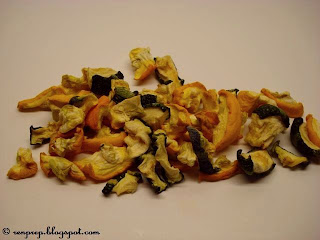
Another dehydrated staple in my pantry are dehydrated zucchini chunks: they too can be added to winter dishes to add bulk and color. Take advantage of all those gardeners that have zucchini coming out of their ears and crank up the dehydrator, this winter you will be glad you did!

Canning jars are expensive to purchase at first, but they are well worth the price. If you browse yard sales, thrift stores and online auctions, you will often find canning jars for sale. Make sure they are Ball or Kerr brand, as mayonnaise jars or other glass containers will not withstand the pressure or maintain an airtight seal. When you do find canning jars, run your finger carefully across the rim. It should be smooth, with no knicks or chips. This will affect the airtight seal and may compromise the strength of the glass. Many a jar has broken while boiling in a canner because of a hairline crack in the glass.
Canning is fun, but should also be taken seriously. Make sure you understand what should be canned in a pressure canner and what can be canned in a water bath. Oven canning is not recommended, nor is steamer canning. Educate yourself (even if you are an experienced canner, you may want to look into the Extension courses, they share the latest on food safety information!) and familiarize yourself with requirements, safety issues and recipes for the foods you love. Use recipes from an approved source such as the Extension office or the Ball Blue Book.
Dehydrating is literally taking all the water out of food so you can store it dry. It also greatly reduces volume and weight, but not necessarily flavor. Dehydrated tomatoes, for example, have a wonderful deep tomato flavor, because all the water has evaporated, but all the flavor stays.

Today, I canned peaches that were soaked in a star anise/cinnamon stick syrup (see above), and I dehydrated several pounds of tomato chunks. Fresh from the garden, I washed, chopped and drained red and yellow tomatoes, then laid them on the dehydrator for approx. 9 hours on 135F. Once dried, a handful added to a stew or a soup this winter will be a wonderful reminder of summer.
Another dehydrated staple in my pantry are dehydrated zucchini chunks: they too can be added to winter dishes to add bulk and color. Take advantage of all those gardeners that have zucchini coming out of their ears and crank up the dehydrator, this winter you will be glad you did!

Building your food pantry $5 at a time
I received an email the other day that boasted having a system to build an affordable food pantry, $5 a week at a time. The concept in itself is great: purchase an additional five dollars of food items each week and after 12 months (or a mere $260) you will have enough food to hold you and your significant other over in times of crisis, lay-offs or other equally disastrous times. The article then showed the list of items to purchase: salt, sugar, cans of cream of chicken, mushroom and tomato soup, macaroni, wheat, yeast, tuna, powdered milk, mac&cheese, peanut butter, honey, shortening, aspirin and vitamins. Great list if you like and eat all those products.....but if I were to subsist on cream of mushroom soup, tuna and peanut butter, something else would be in crisis too: I would!
I was floored when I read that list: it read like a random shopping list instead of a well-planned pantry. What's the purpose of buying wheat unless you have a mill (and how are you going to power it?) to grind it and make flour to bake bread or biscuits with. I get the mac&cheese, but what am I doing with the macaroni itself? Boil it in tomato soup? Ewwwwwwwww.........and where are the veggies, where's the fruit? In times of crisis, you need comfort food to keep you going, something sweet, something familiar. The last thing you want to do, when all heck breaks loose, is learning how to feed your family on storage food that you don't use in your day-to-day cooking. You will be hard-pressed to find any canned cream soups in my pantry, or mac&cheese. It is not something I normally eat or use so I don't store it either.
Learn how to make your bread, cream soups and other dishes from scratch, so that you can focus on pantry staples instead of processed foods. Basic items like flour, sugar, salt, yeast, dehydrated milk, oils, pasta, rice, beans, dehydrated or canned fruits and vegetables......there's a myriad of dishes you can prepare with it and it will be a lot cheaper as most of these can be purchased in bulk.
Keep a check on what items you purchase the most, what have become staples on your shopping list? Those are the ones you want to stash away for later use and those will be a comfort when everything around you changes. When you buy, or when these staples are on sale, buy two additional cans, or an extra bag or another pound and put it in your food pantry. As these items are used frequently, you will have no trouble rotating them and using them up before they spoil. By adding on an extra $5 a week, when you have it, can quickly add to the security of knowing that you have enough to keep your head above water.
I was floored when I read that list: it read like a random shopping list instead of a well-planned pantry. What's the purpose of buying wheat unless you have a mill (and how are you going to power it?) to grind it and make flour to bake bread or biscuits with. I get the mac&cheese, but what am I doing with the macaroni itself? Boil it in tomato soup? Ewwwwwwwww.........and where are the veggies, where's the fruit? In times of crisis, you need comfort food to keep you going, something sweet, something familiar. The last thing you want to do, when all heck breaks loose, is learning how to feed your family on storage food that you don't use in your day-to-day cooking. You will be hard-pressed to find any canned cream soups in my pantry, or mac&cheese. It is not something I normally eat or use so I don't store it either.
Learn how to make your bread, cream soups and other dishes from scratch, so that you can focus on pantry staples instead of processed foods. Basic items like flour, sugar, salt, yeast, dehydrated milk, oils, pasta, rice, beans, dehydrated or canned fruits and vegetables......there's a myriad of dishes you can prepare with it and it will be a lot cheaper as most of these can be purchased in bulk.
Keep a check on what items you purchase the most, what have become staples on your shopping list? Those are the ones you want to stash away for later use and those will be a comfort when everything around you changes. When you buy, or when these staples are on sale, buy two additional cans, or an extra bag or another pound and put it in your food pantry. As these items are used frequently, you will have no trouble rotating them and using them up before they spoil. By adding on an extra $5 a week, when you have it, can quickly add to the security of knowing that you have enough to keep your head above water.
Saturday, August 28, 2010
It's not all doom and gloom....
Just a quick one to encourage you for the day....Life is good!
There was an old man and woman who had been married for over fifty years. Times were very tough and food was scarce. The old woman, driven by hunger, broke into the neighbor's root cellar and stole a jar of peaches. She was caught and brought before the judge.
After the trial was done the judge, showing pity on the old woman, asked how many peaches were in the jar. "Five, your Honor", she said. The judge said: "Then I will give you one day for each peach. You will serve five days in jail".
From the back of the court room her husband shouted:"Your Honor, she also stole a big can of peas!"
LOL - too funny! So in case push comes to shove, leave the peas and go for the peaches :-)
There was an old man and woman who had been married for over fifty years. Times were very tough and food was scarce. The old woman, driven by hunger, broke into the neighbor's root cellar and stole a jar of peaches. She was caught and brought before the judge.
After the trial was done the judge, showing pity on the old woman, asked how many peaches were in the jar. "Five, your Honor", she said. The judge said: "Then I will give you one day for each peach. You will serve five days in jail".
From the back of the court room her husband shouted:"Your Honor, she also stole a big can of peas!"
LOL - too funny! So in case push comes to shove, leave the peas and go for the peaches :-)
Thursday, August 26, 2010
Shine a light............
In February I asked you to find your flashlight. Did you find it? Are the batteries still good? If you don't have a flash light, try to buy one on your next shopping trip: they're easy to find in second-hand stores or dollar stores. The dollar store is usually also the place to buy cheap batteries, so be on the lookout for those!
Power outages are frequent (at least in this part of the country). Having flashlights, and knowing where they are, is key to your safety during those times. A large variety of options are available nowadays, both battery-free, and with batteries. You can have squeeze flashlights (no batteries, the light is manually activated by squeezing the handle) or crank flashlights (you turn a crank for 30 seconds that will activate the light for up to five minutes). These are great if you don't want to invest in spare batteries or want to make sure you always have a working flashlight.
You may also want to invest in one of those headbands with LED lights. They allow you to have both of your hands available (it's easier to cook in the dark if you have a light shining from your head than holding a flash light in one and stirring with the other!).
I keep one flash light by the bed, one in the kitchen and one in each room of the house, usually in the top drawer. Each room usually has a drawer of some sort. Don't forget to place one in the bathrooms and more importantly, one in whichever room your breaker panel is at.
Candles and oil lamps are good to have for long term darkness, but open flames are NOT encouraged, it's way too dangerous. Make sure you understand how oil lamps work, and have abundant tea light candles that can be burnt in small holders. Long tapered candles will easily fall over or spill wax. By all means, do not leave any candles unattended!
Power outages are frequent (at least in this part of the country). Having flashlights, and knowing where they are, is key to your safety during those times. A large variety of options are available nowadays, both battery-free, and with batteries. You can have squeeze flashlights (no batteries, the light is manually activated by squeezing the handle) or crank flashlights (you turn a crank for 30 seconds that will activate the light for up to five minutes). These are great if you don't want to invest in spare batteries or want to make sure you always have a working flashlight.
You may also want to invest in one of those headbands with LED lights. They allow you to have both of your hands available (it's easier to cook in the dark if you have a light shining from your head than holding a flash light in one and stirring with the other!).
I keep one flash light by the bed, one in the kitchen and one in each room of the house, usually in the top drawer. Each room usually has a drawer of some sort. Don't forget to place one in the bathrooms and more importantly, one in whichever room your breaker panel is at.
Candles and oil lamps are good to have for long term darkness, but open flames are NOT encouraged, it's way too dangerous. Make sure you understand how oil lamps work, and have abundant tea light candles that can be burnt in small holders. Long tapered candles will easily fall over or spill wax. By all means, do not leave any candles unattended!
Subscribe to:
Posts (Atom)
